

Light Industrial Design: A Complete Guide for BC Businesses
Light Industrial Design: How to Build Functional, Code-Compliant Spaces in BC
Light industrial design is the planning and design of buildings used for assembly, light manufacturing, warehousing, distribution, and related office functions, where operations are low-impact enough to sit near commercial and sometimes residential areas. Good light industrial design balances four things: efficient loading and circulation, adequate clear ceiling height, an integrated office and warehouse layout, and full compliance with the BC Building Code.
In Metro Vancouver, where industrial land is scarce and expensive, the difference between an average and an excellent design is measured in usable square footage, operating efficiency, and how well the building represents the brand inside it.
What is light industrial design?
Light industrial design covers the architecture and interior design of facilities used for activities like assembly, packaging, food production, distribution, light manufacturing, and warehousing. The defining feature is intensity. Light industrial uses generate less noise, traffic, emissions, and hazard than heavy industrial operations, which is why municipalities allow them closer to commercial corridors and, in some cases, residential neighbourhoods.
The contrast with heavy industrial design is the question we field most often. Heavy industrial design covers operations like steel mills, chemical plants, and large-scale processing, which involve high hazard, significant emissions, and heavy infrastructure, and are zoned well away from people. Light industrial sits at the other end: a craft brewery, a food importer’s warehouse and test kitchen, a plywood distribution centre, an advanced battery assembly facility. These businesses need industrial bones, including loading docks, high ceilings, and durable structure, but they also need clean, presentable, often brand-forward interiors because staff, customers, and partners spend time inside them.
That dual nature is what makes light industrial building design its own discipline. You are designing a working warehouse and a workplace at the same time, and the best facilities make that combination look effortless. This guide walks through how light industrial spaces are zoned and classified in BC, the design decisions that matter most, the code requirements you cannot skip, and how working with the right architect turns a basic box into a high-performing asset.
How light industrial zoning and occupancy classification work in BC
Before any design begins, two systems govern what you can build: municipal zoning and the BC Building Code occupancy classification. They are different things, and confusing them is a common and expensive mistake.
Zoning is local. Each municipality in Metro Vancouver, from Burnaby to Langley to Maple Ridge, defines industrial zones such as light industrial (often labelled I or M zones), and those bylaws control what uses are permitted, how much office space is allowed, setbacks, parking ratios, and loading requirements. A use that is permitted outright in one city may need a rezoning or a variance in another. Confirming zoning before signing a lease or purchase agreement is the single most important step, because it determines whether your intended operation is even legal on that site.
Occupancy classification is provincial. The BC Building Code groups industrial buildings under Group F, divided by hazard level: F1 for high-hazard industrial, F2 for medium-hazard, and F3 for low-hazard. Most light industrial operations fall under F2 or F3. This classification drives fire separations, sprinkler requirements, exiting, and allowable building size. When a facility also contains offices, it becomes a mixed-occupancy building (Group F combined with Group D business occupancy), which adds another layer of code requirements for separating and connecting the two.
| Classification | Hazard Level | Typical Uses | Key Implications |
|---|---|---|---|
| F1 | High hazard | Chemical plants, refineries, steel mills, large-scale processing | Heaviest fire separations, strict sprinkler requirements, zoned well away from commercial and residential areas |
| F2 | Medium hazard | Assembly, light manufacturing, warehousing, auto repair, food production | Standard sprinkler requirements, most common classification for light industrial operations in Metro Vancouver |
| F3 | Low hazard | Warehousing of non-combustible goods, low-risk storage, distribution | Least restrictive requirements, commonly combined with Group D (business) occupancy for mixed office and warehouse facilities |
The design considerations that make or break a light industrial building
Once zoning and classification are confirmed, the design work begins. A handful of decisions account for most of a facility’s long-term performance, and getting them right early is far cheaper than fixing them later.
Loading access and site circulation
Nothing cripples an industrial operation faster than poor loading. The design has to match the vehicles that will actually serve the building. Dock-high doors suit trailer-based distribution, while grade-level doors suit vans, smaller trucks, and drive-in operations. Many facilities need both. Beyond the doors themselves, the site must give trucks room to turn, queue, and back in without blocking traffic, which means planning the yard depth, drive aisles, and turning radii for the largest expected vehicle. On the tight, expensive lots common in Metro Vancouver, efficient site circulation often does more for throughput than any interior decision.
Clear ceiling heights and structure
In a warehouse, vertical space is money. Clear height, the unobstructed distance from floor to the lowest overhead obstruction, determines how high you can rack and store product. Modern light industrial buildings target roughly 24 to 32 feet of clear height, while older stock often sits at 18 to 24 feet. The structural grid matters too: wider column spacing means more flexible racking and easier vehicle movement. These decisions interact with sprinkler design and storage height limits, so they need to be coordinated from the start rather than assumed.
| Building Type | Typical Clear Height | Considerations |
|---|---|---|
| Older industrial stock | 18 – 24 ft | Limits racking height and storage density; verify before committing to a lease |
| Modern light industrial | 24 – 32 ft | Coordinate sprinkler design and storage height from the start; high-pile storage above code thresholds requires an ESFR system and a high-pile storage permit |
Mezzanines: extra space without extra footprint
When land is scarce, building up is often smarter than building out. A mezzanine adds usable area for offices, storage, or staff amenities without expanding the footprint. The catch is code. Under the BC Building Code, a mezzanine larger than a set proportion of the floor area below it triggers additional requirements, and a large enough mezzanine is treated as a full storey, which changes exiting, sprinklering, and allowable area. A well-designed mezzanine captures the benefit while staying on the right side of those thresholds, which is exactly the kind of judgment an experienced light industrial architect brings.
Integrating office and warehouse space
Almost every light industrial facility needs both warehouse and office, and how you stitch them together defines the daily experience. Good warehouse office design separates the two functions acoustically and environmentally, since office staff need quiet, climate control, and daylight, while the warehouse runs loud, dusty, and temperature-variable. At the same time, the connection between them, including sightlines from the office into operations, a clear path for staff, and a presentable transition for visitors, shapes culture and efficiency. The best facilities treat the office not as a leftover corner but as a designed workplace that happens to sit inside an industrial shell.
BC building code requirements you can’t skip
Code compliance is not a formality at the end. It shapes the design from the first sketch, and skipping it leads to failed inspections, costly retrofits, and delayed occupancy.
Fire and life safety lead the list. Sprinkler systems are required for most light industrial buildings, and high-pile or rack storage often demands an ESFR (early suppression, fast response) system plus a high-pile storage permit, both of which affect ceiling height and water supply. Exiting is governed by occupant load and travel distance, which is why office and production areas need carefully placed exits. Where offices and warehouse share a building, the code requires rated fire separations between the different occupancies.
Accessibility, energy, and environmental rules round out the picture. The BC Building Code and the BC Energy Step Code set requirements for accessible entrances, washrooms, and paths of travel, as well as building envelope and mechanical efficiency. Specialized operations add their own layers: a food facility like Qualifirst must meet health-authority and food-safety standards on top of the building code, and a battery or chemical-adjacent operation triggers additional hazardous-materials and ventilation requirements. Mapping every applicable code early is what keeps a project on schedule.
Lessons from Cutler’s light industrial projects
Principles are easier to trust when you can see them at work. Cutler’s recent light industrial projects across the Lower Mainland show how these decisions play out in real buildings.
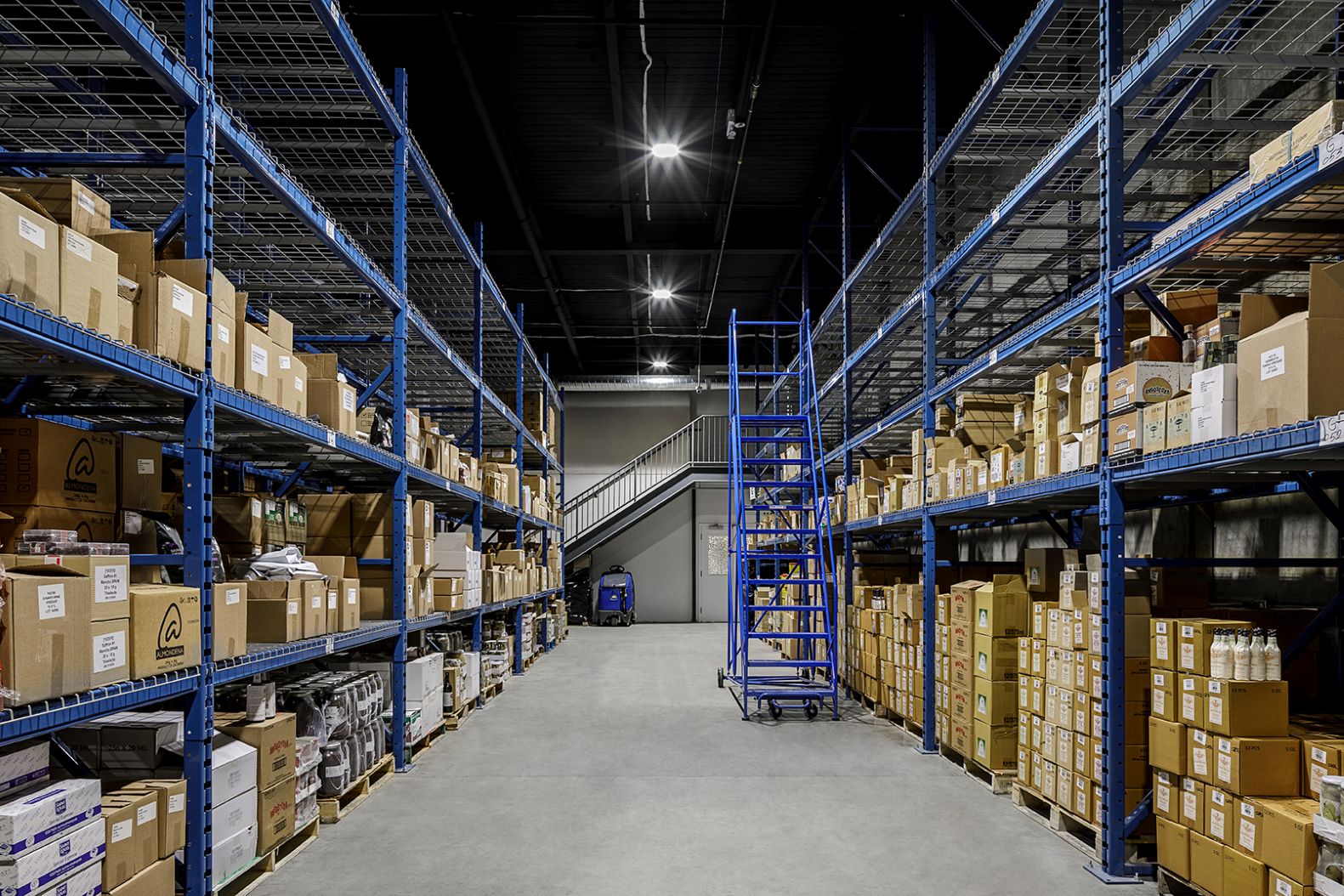
Qualifirst in Burnaby is a 27,293-square-foot facility for a specialty food importer and distributor, combining a food-grade warehouse with a commercial kitchen and office space. The project shows how demanding integration can get: food-safety standards, temperature control, and clean production zones had to coexist with high-volume warehousing and a professional office, all under one roof. It is a clear example of why warehouse office design has to be planned as a whole, not assembled from separate parts.
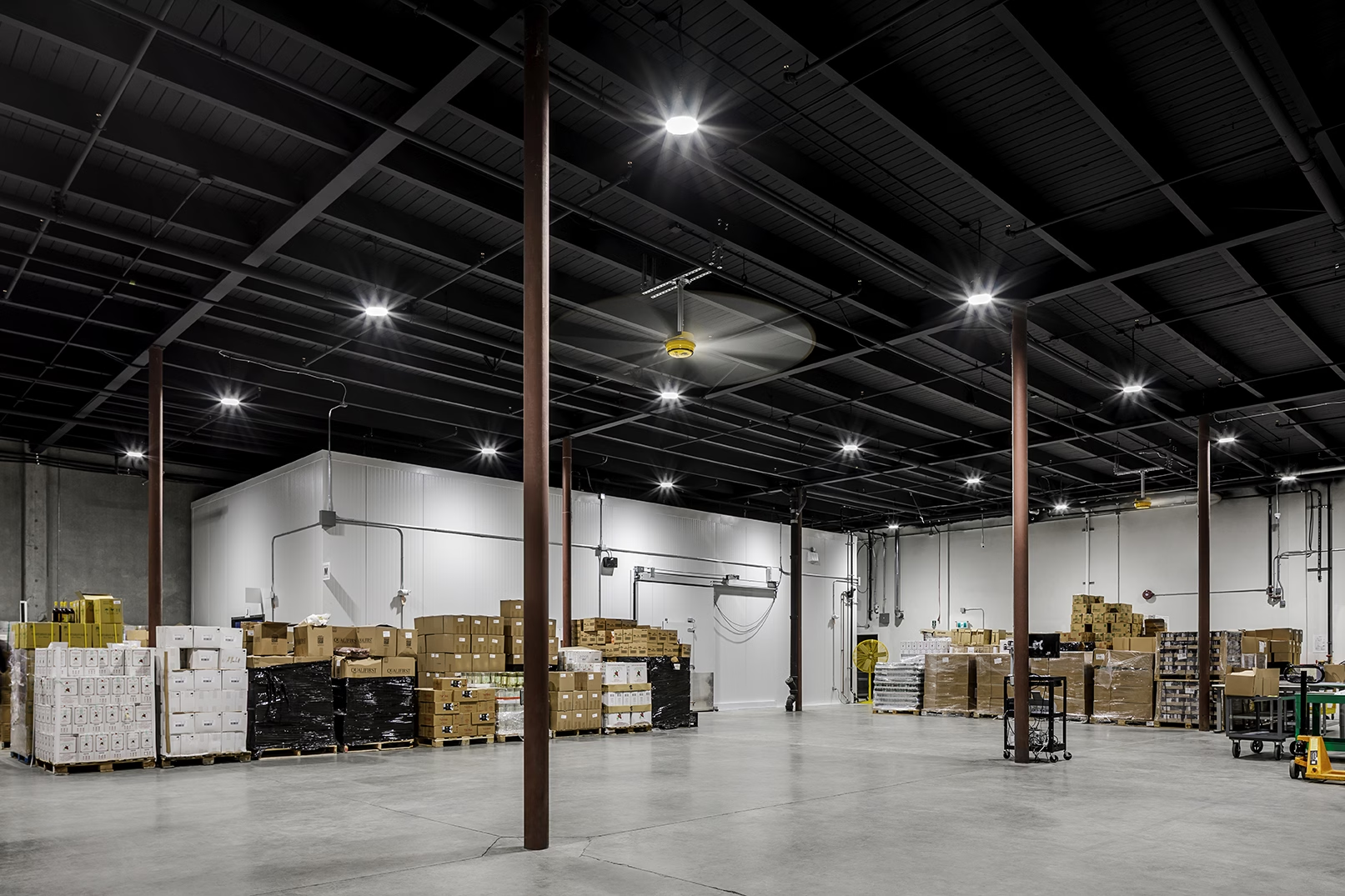
Windsor Plywood in Langley is a 14,500-square-foot plywood warehouse and distribution facility. Here the priorities were heavy product handling, efficient racking and loading for building materials, and a customer-facing presence that reflects the brand. It illustrates the balance light industrial design so often demands: a building that works hard operationally while still presenting well to the people who walk through the door.
Two further projects, Mangrove and Molicel, are in progress and push the type further. Molicel, an advanced battery manufacturer, represents the higher-technology end of light industrial, where precise environmental control, specialized servicing, and stringent safety requirements drive the design. Mangrove adds another contemporary example of how light industrial space can be both highly functional and considered in its detailing. Across all four, the throughline is the same: facilities designed around how the business actually operates outperform generic industrial boxes.
Making it brand-forward: industrial interior design that works
There is a lingering assumption that industrial buildings are purely utilitarian. That is outdated. Industrial interior design has become a real differentiator, because these facilities now host staff full time, welcome customers and partners, and serve as a recruiting tool in a tight labour market.
Brand-forward does not mean impractical. It means durable materials chosen with intent, good natural light in the office and amenity zones, clear wayfinding, and a reception and office environment that reflects the company’s identity rather than apologizing for its industrial setting. We have seen the same square footage feel completely different depending on whether the interior was designed or merely built. A considered industrial interior raises daily morale, signals quality to visitors, and protects the value of the asset, all without compromising the operational performance that justified the building in the first place.
Working with a light industrial architect in BC, step by step
Most operators have never run an industrial build and are unsure how the process unfolds. Engaging a light industrial architect in BC early gives you a clearer path and fewer surprises. The phases below are typical.
- Feasibility and due diligence. Before you commit to a site, the architect confirms zoning, occupancy classification, and whether your intended use fits the building and land. This stage prevents the most expensive mistakes.
- Programming and test fits. Your operational requirements, including racking, production flow, office headcount, and loading, are translated into a space program and tested against the actual building or site to confirm it works.
- Schematic and detailed design. The layout, structure, mezzanines, office integration, and interior design are developed, with cost estimates refined along the way.
- Permitting and documentation. The full drawing set is produced for building permits, and the architect manages the municipal approval process, including any specialized permits such as high-pile storage.
- Construction administration. During the build, the architect coordinates trades, reviews changes, and protects the design intent through to occupancy, then assists with move-in and deficiencies.
Bringing the architect in at feasibility, not after a lease is signed, is consistently the highest-value decision. It is far cheaper to confirm a building works on paper than to discover after the fact that the clear height is too low or the loading does not suit your trucks.
How much does light industrial design and construction cost in Metro Vancouver?
Cost is the question every owner wants answered first, and the honest response is that it depends heavily on scope. As a planning guide, a straightforward warehouse fit-out in Metro Vancouver often runs in the range of roughly 40 to 90 dollars per square foot, while the office and amenity portions built to a professional standard typically cost significantly more per square foot because of finishes, mechanical systems, and partitioning. Specialized uses, such as food production, cold storage, or advanced manufacturing, carry higher costs again due to their equipment, servicing, and code requirements.
Several factors swing the number: the condition of the base building, clear height and structural upgrades, the ratio of office to warehouse, sprinkler and electrical capacity, and the level of interior finish. Because Metro Vancouver industrial land and construction costs are among the highest in Canada, the value of good design is amplified here, since every inefficient square foot is expensive to lease and build. The only reliable way to budget is a real estimate based on your specific operation and site, which is exactly what the feasibility and programming stages are designed to produce.
Frequently asked questions
What is light industrial design and how does it differ from heavy industrial?
Light industrial design is the design of buildings for low-impact industrial uses such as assembly, warehousing, distribution, light manufacturing, and food production, where operations produce limited noise, traffic, and hazard. Because the impact is modest, these facilities are often permitted near commercial and sometimes residential areas, and they typically combine warehouse space with offices and customer-facing zones.
Heavy industrial, by contrast, covers high-hazard, high-impact operations like steel mills, refineries, and chemical plants, which require heavy infrastructure and are zoned well away from populated areas. In the BC Building Code, this difference shows up in occupancy classification: light industrial usually falls under medium- or low-hazard Group F (F2 or F3), while high-hazard heavy industrial falls under F1, with stricter requirements.
What are the key design requirements for a light industrial building in BC?
The core requirements are efficient loading and site circulation, adequate clear ceiling height for racking and storage, a structural grid that supports flexible operations, and a well-integrated office and warehouse layout. On top of these, the building must satisfy the BC Building Code for fire separations, sprinklers, exiting, accessibility, and energy performance under the Energy Step Code.
Zoning adds a parallel set of requirements that vary by municipality, including permitted uses, allowable office ratios, parking, and loading provisions. Confirming both the local zoning bylaw and the provincial occupancy classification before design begins is essential, because together they determine what you can legally build and operate on a given site.
How do you integrate office and warehouse space in a light industrial facility?
Successful integration separates the two environments while keeping them connected. The office needs quiet, climate control, daylight, and a professional finish, so it is acoustically and thermally separated from the warehouse, which is louder, dustier, and temperature-variable. The BC Building Code requires rated fire separations between the office (Group D) and warehouse (Group F) occupancies, so this division is both a comfort and a code matter.
At the same time, the connection between the two areas shapes daily efficiency and culture. Thoughtful sightlines from the office into operations, a clear and presentable transition for visitors, and convenient staff circulation all matter. The best facilities, such as Cutler’s Qualifirst project, treat the office as a designed workplace within the industrial shell rather than a leftover corner.
What building permits are required for a light industrial fit-out in British Columbia?
At minimum, a light industrial fit-out in BC requires a building permit from the local municipality, which reviews the project against the BC Building Code and zoning bylaws. Depending on the work, you may also need electrical, mechanical, and plumbing permits, along with a high-pile storage permit if you intend to rack product above the code-defined height, which affects sprinkler design.
Specialized operations carry extra approvals. A food facility needs health-authority sign-off and must meet food-safety standards, a business serving the public may trigger accessibility upgrades, and operations involving hazardous materials require additional review. An experienced light industrial architect maps the full permit list at the start of the project and manages the approvals, which keeps the schedule predictable.
How much does it cost to design and build a light industrial space in Metro Vancouver?
Costs vary widely with scope, but as a planning range, a basic warehouse fit-out in Metro Vancouver often falls around 40 to 90 dollars per square foot, while office and amenity areas built to a professional standard cost considerably more per square foot. Specialized uses such as cold storage, food production, or advanced manufacturing push costs higher because of equipment, servicing, and stricter code requirements.
The biggest cost drivers are the condition of the base building, required structural or clear-height upgrades, the office-to-warehouse ratio, sprinkler and electrical capacity, and the level of interior finish. Because Metro Vancouver has some of the highest industrial land and construction costs in Canada, a reliable budget always comes from a project-specific estimate developed during the feasibility and programming stages, not from a generic per-foot figure.
Planning a light industrial facility?
Light industrial design rewards the businesses that plan early. The decisions made before construction, including site selection, clear height, loading, office integration, and code strategy, shape how efficiently the facility operates for the entire length of its life. As a full-service commercial architecture and interior design firm working across British Columbia, Cutler designs light industrial facilities that are functional, code-compliant, and brand-forward, from food and distribution warehouses to advanced manufacturing.
If you are evaluating a site, planning a new facility, or fitting out an existing industrial building, we would be glad to talk.