

Retail Space Design: How to Create a Store That Converts Browsers into Buyers
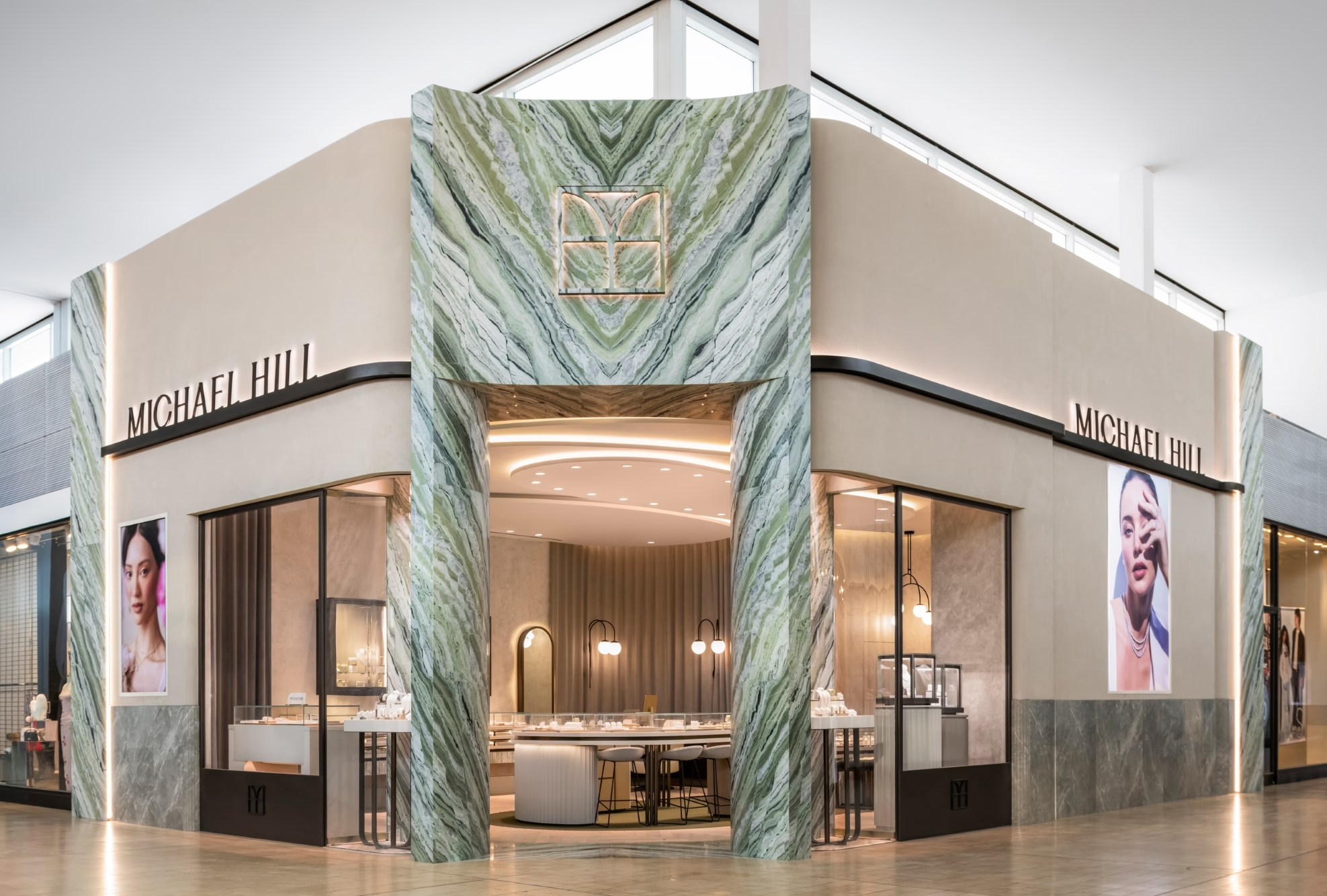
Retail space design is the strategic planning of a store’s layout, flow, lighting, fixtures, and visual merchandising to guide customers through the space and turn browsing into buying. Effective retail space design works on behaviour: it slows shoppers down in the right places, leads them past more product, and makes the act of buying feel easy and on-brand. The best stores are not decorated, they are designed, with every sightline, fixture, and light chosen to support how people actually move and decide.
What is retail space design?
Retail space design is the discipline of shaping a physical store so it sells. It brings together architecture, interior design, lighting, fixtures, and visual merchandising into one coordinated environment that reflects the brand and moves customers toward a purchase. It is different from simply decorating a space. A decorated store looks nice. A designed store performs, measured in conversion rate, average transaction value, and how long customers stay.
“A decorated store looks nice. A designed store performs — measured in conversion rate, average transaction value, and how long customers stay.”
This matters more than ever because physical retail now competes with the convenience of online shopping. A store cannot win on price or selection alone, so it has to win on experience. That experience is built deliberately: the moment a customer steps inside, the path their eyes and feet take, the products that catch their attention, and the ease of paying and leaving. When those elements work together, a store becomes a powerful sales tool rather than just a place to hold inventory.
This guide covers how retail space design influences buying behaviour, the main store layout types and when to use each, how to plan traffic flow, the role of lighting and visual merchandising, how much space you actually need, and how to work with a Canadian design firm to bring it all together. Along the way, we will look at real examples from Cutler’s retail work, including the new wave of stores at Oakridge Park in Vancouver.
How retail space design affects customer buying behaviour
Store design is applied psychology. Decades of retail research, much of it pioneered by retail anthropologist Paco Underhill, show that customers behave in predictable ways once they enter a store, and good design works with those patterns rather than against them.
Two findings shape almost every layout. First, most shoppers entering a store drift to the right, which is why the front-right area, sometimes called the power wall, earns premium product placement. Second, the first few steps inside the door are a transition or decompression zone where customers adjust from the outside world and tend to overlook merchandise and signage placed there. Pushing key product right up to the entrance wastes it. Designers leave that zone open and place the first real display a little deeper, where shoppers are ready to engage.
The other lever is dwell time. The longer a customer stays, the more they tend to buy, so much of retail space design is about comfortable, unhurried movement: wide enough aisles that shoppers are not bumped from behind, clear sightlines that pull them deeper into the store, and “speed bumps” like feature tables that interrupt the walk and invite a pause. Get this right and the store quietly does the selling for you.

Retail store layout types and when to use them
Layout is the skeleton of retail space design. A handful of proven typologies cover most stores, and choosing the right one depends on what you sell and how you want people to shop.
Grid layout
The grid uses long, parallel aisles and is the familiar layout of grocery stores, pharmacies, and big-box retail. It is efficient, easy to navigate, and maximizes product density, which makes it ideal when customers come in knowing what they want. The trade-off is that grids feel functional rather than inspiring, so they suit convenience-driven retail more than experience-driven brands.
Loop or racetrack layout
The loop guides customers along a defined path that circles the store and returns them to the entrance, exposing them to a wide range of product along the way. Department stores and larger fashion retailers use it to maximize the merchandise each shopper passes. It is one of the strongest layouts for encouraging discovery, as long as the path stays clear and the journey feels intentional rather than forced.
Free-flow layout
The free-flow layout abandons rigid aisles in favour of an open plan with fixtures arranged to create a relaxed, exploratory feel. It is the default for boutiques, luxury, and fashion, because it signals quality and gives each product room to breathe. Free-flow demands the most design skill, since without strong sightlines and focal points it can feel aimless. Done well, it is the most flexible and brand-forward of all the typologies.
| Layout | Best For | Key Strength | Trade-off |
|---|---|---|---|
| Grid | Grocery, pharmacy, big-box, convenience retail | Efficient navigation, maximum product density | Feels functional rather than inspiring |
| Loop / Racetrack | Department stores, larger fashion retailers | Maximizes merchandise exposure, encourages discovery | Path must stay clear and feel intentional, not forced |
| Free-flow | Boutiques, luxury, fashion | Signals quality, most flexible and brand-forward of all typologies | Demands the most design skill; without strong sightlines and focal points it can feel aimless |
Designing the customer journey: traffic flow and sightlines
Once the layout is chosen, retail space planning turns to the journey itself. The goal is to lead customers naturally through as much of the store as possible without making them feel managed.
Strong sightlines do the heavy lifting. When a customer can see an appealing display at the back of the store, they are drawn toward it, pulling them past everything in between. Designers use focal points, a feature wall, a hero product, a striking fixture, as visual magnets that keep people moving deeper. Essentials and high-demand items are often placed toward the back for the same reason, so shoppers travel through tempting product to reach them.
Pacing matters too. A store that is one uninterrupted walk encourages customers to breeze through, so designers add deliberate pauses: a central table, a styled vignette, a change in flooring or lighting that signals a new zone. Each pause is a chance to engage. The checkout deserves the same care, positioned where it is easy to find but not so close to the door that it rushes the experience. Every one of these decisions is invisible to the customer and obvious in the sales numbers.
Lighting, fixtures, and materials that sell
If layout is the skeleton, lighting is the nervous system. Lighting shapes mood, directs attention, and makes product look its best, and it is one of the most underused tools in retail. A strong scheme layers three types: ambient light for overall visibility, accent light to spotlight feature product and create contrast, and task light at fixtures and the till. Warm colour temperatures tend to flatter fashion, food, and luxury goods, while cooler light suits a clean, technical feel.
Fixtures and materials carry the brand. The same dress reads as fast fashion on a crowded chrome rack and as luxury on a single solid-wood plinth, and customers absorb that message instantly. Quality materials, considered detailing, and fixtures that frame rather than crowd the product all signal where a brand sits in the market. This is where retail store design ideas earn their keep: a well-chosen material palette and lighting scheme can lift the perceived value of the same merchandise, supporting higher prices and stronger margins. The finishes are not decoration, they are part of the pricing strategy.
| Layer | Purpose | Where It Works |
|---|---|---|
| Ambient | Overall visibility throughout the store | Base layer across the entire floor |
| Accent | Spotlight feature product and create contrast | Hero product, feature displays, window |
| Task | Practical illumination to support transactions | Fixtures, fitting rooms, and the till |
Visual merchandising design: turning product into stories
Visual merchandising design is how product is presented to attract, engage, and convert. It runs from the window display that stops someone on the sidewalk to the way items are grouped, styled, and lit inside. While layout and lighting set the stage, visual merchandising is the performance that happens on it.
A few principles drive results. The window is the store’s most valuable advertising space and should tell a clear, current story rather than simply showing stock. Inside, product is most often merchandised at eye level, where it sells best, with a recognizable focal arrangement, sometimes called the golden triangle, drawing the eye to a styled grouping. Cross-merchandising, placing complementary items together, lifts add-on sales by making the next purchase obvious. None of this is accidental. Strong visual merchandising is planned alongside the architecture so the fixtures, lighting, and product styling reinforce one another instead of competing.
How much retail space do you need? Retail space planning in Canada
Sizing a store is a balance between presence and productivity. Too little space and the store feels cramped and limits range; too much and you pay rent on floor that does not earn its keep. As a rough guide for Canadian retail, a focused boutique often works in roughly 800 to 2,000 square feet, a standard apparel or specialty store in the 2,000 to 5,000 square foot range, and larger format or flagship stores well beyond that. These are starting points, not rules, because the right size depends entirely on format, product, and location.
The more useful question is how the space is allocated. Sales floor, back-of-house storage, fitting rooms, and checkout each need their share, and the ratio varies by category. A luxury boutique devotes more area per product to create a sense of space, while a high-turnover store maximizes sales floor density. Retail space planning is about getting these proportions right for your specific business, which is why a test fit on a candidate unit, before you sign the lease, is one of the smartest early moves a retailer can make. It confirms whether a space can actually hold the store you have in mind.
| Format | Typical Size (sq ft) |
|---|---|
| Focused boutique | 800 – 2,000 |
| Standard apparel or specialty store | 2,000 – 5,000 |
| Flagship or large-format store | Beyond 5,000 |
These are starting points, not rules. The right size depends on format, product, and location. A test fit before signing the lease confirms whether a specific unit works for your store.
Retail store design ideas on a tight budget
Great retail design is not only for brands with unlimited budgets. When money is tight, the trick is to spend it where customers look and feel, and save everywhere else. Concentrate the budget on the highest-impact zones: the window, the entrance, and the checkout, since these shape first impressions and final impressions far more than a back corner does.
Lighting is the best value in retail design, because upgrading the lighting scheme transforms how product looks for a fraction of the cost of a full renovation. Flexible, modular fixtures are another smart investment, letting you restyle the store for new seasons or collections without rebuilding. A single strong design feature, such as a bold feature wall or a custom counter, creates a memorable moment that a thin layer of finishes spread across every surface never will. Even a modest budget, focused with discipline, can produce a store that punches well above its cost, which is exactly the kind of prioritization an experienced designer brings to the table.
Where to spend first
- Window — your most valuable advertising space; it determines whether someone steps inside
- Entrance — shapes the first impression and sets the tone for the entire store
- Checkout — the last thing a customer experiences; it shapes whether they come back
- Lighting upgrade — the best value in retail design; transforms how product looks for a fraction of renovation cost
- Flexible, modular fixtures — let you restyle for new seasons without rebuilding
- One strong design feature — a bold feature wall or custom counter creates a memorable moment that thinly spread finishes never achieve
Lessons from Oakridge Park: retail design in action
Vancouver’s new Oakridge Park development is a live showcase of retail space design at the premium end, and several of the brands opening there are Cutler clients. These projects show how layout, lighting, fixtures, and visual merchandising come together when a store has to embody a global brand in a flagship setting.
Valentino opened its store at the Oakridge Park grand opening in late May, an example of luxury retail design where restraint, material quality, and carefully controlled sightlines do the work. In a luxury environment, the design gives product room and uses lighting and finish to signal exclusivity, the opposite of density-driven retail. Several more Cutler clients are opening at Oakridge Park in the coming months, including the French fragrance house Diptyque, Canadian jeweller Lugaro, and Parisian patisserie Delysees, each bringing a distinct brand world that the store design has to translate into three dimensions.
What these projects share is the principle at the heart of this guide: the store is the brand made physical. A fragrance boutique, a jewellery showcase, and a patisserie each demand completely different design responses, yet all rely on the same fundamentals of flow, focal points, lighting, and merchandising. Designing for a flagship at Oakridge Park simply raises the stakes on getting those fundamentals exactly right.

Working with a Canadian retail design firm on your retail fit-out
Most retailers focus on product and brand, not construction, so partnering with a design firm experienced in retail fit-outs removes a great deal of risk. The process typically follows a clear sequence. It begins with discovery, where the designer learns your brand, customer, and sales goals, then moves to space planning and test fits that confirm a unit works before you commit to it. From there, the design is developed in detail, documented for permits and construction, and built out under the designer’s coordination through to opening day.
Working with a Canadian retail design firm like Cutler brings specific advantages for retailers here. Local designers know the building codes, accessibility requirements, and permit processes in each municipality, as well as the realities of landlord and mall design criteria, which are strict in premium centres like Oakridge Park. They also understand local construction costs and timelines, so the budget and schedule are grounded in reality. For a retailer opening in a new market or a flagship location, that local knowledge is the difference between a smooth opening and a costly scramble. The earlier the designer is involved, ideally before the lease is signed, the more value they add.
Frequently asked questions
What are the most effective retail store layout types?
The three most effective and widely used layouts are the grid, the loop (or racetrack), and the free-flow. The grid uses parallel aisles for efficient, high-density navigation and suits grocery, pharmacy, and convenience retail. The loop guides customers along a set path that circles the store, maximizing product exposure, which works well for department and larger fashion stores. The free-flow layout uses an open, fixture-led arrangement that signals quality and encourages exploration, making it the standard for boutiques and luxury.
The most effective choice depends on what you sell and how customers shop. Convenience-driven categories benefit from the grid’s efficiency, while experience-driven and premium brands gain more from the loop or free-flow. Many successful stores blend typologies, using a grid in one zone and free-flow in another, so the layout matches the way each part of the range is best shopped.
How does retail space design affect customer buying behaviour?
Retail space design directly influences how customers move, what they notice, and how long they stay, all of which affect spending. Research shows shoppers tend to turn right on entering and to overlook the first few feet inside the door, so designers place premium product on the front-right power wall and leave the entrance as an open decompression zone. Clear sightlines and focal points then pull customers deeper into the store, past more merchandise.
Dwell time is the key link to sales. The longer and more comfortably a customer browses, the more they tend to buy, so design choices that slow people down in a pleasant way, such as wide aisles, feature displays, and engaging vignettes, lift conversion and basket size. In short, a well-designed store guides behaviour quietly, making it easier and more enjoyable for customers to discover product and complete a purchase.
What is visual merchandising and how does it relate to store design?
Visual merchandising is the practice of presenting product to attract attention, tell a brand story, and drive sales, from window displays to in-store styling, grouping, and signage. It covers where product sits, how it is arranged, and how it is lit and framed, with techniques like eye-level placement, focal groupings, and cross-merchandising of complementary items to encourage add-on purchases.
It relates to store design as the performance to the stage. Architecture, layout, and lighting create the environment, while visual merchandising is the changing, product-level presentation that happens within it. The two are most powerful when planned together, so the fixtures, lighting, and sightlines built into the store actively support the merchandising rather than working against it. Strong store design makes great visual merchandising possible, and great merchandising realizes the store’s potential.
How much retail space do I need for my store in Canada?
It depends on your format and product, but as a general guide, a focused boutique often works in roughly 800 to 2,000 square feet, a standard apparel or specialty store in the 2,000 to 5,000 square foot range, and flagship or large-format stores well beyond that. These figures are starting points, since a luxury brand needs more space per item to feel exclusive, while a high-turnover store maximizes sales-floor density.
What matters more than the total is the allocation between sales floor, storage, fitting rooms, and checkout, which varies by category. The reliable way to confirm the right size is a test fit on a specific unit before signing the lease, where a designer lays out your intended store on the actual floor plate. This shows whether the space can hold your product range, fixtures, and customer flow, and prevents committing to a unit that is too small or inefficient.
How do I design a retail space on a tight budget?
The key to designing on a budget is to concentrate spending where customers look and feel most, especially the window, entrance, and checkout, and to economize on lower-impact areas. Lighting offers the best return, since upgrading the lighting scheme dramatically improves how the product looks for a fraction of the cost of a full renovation. Flexible, modular fixtures let you restyle the store for new seasons without rebuilding.
A single strong design feature, such as a bold feature wall or a custom counter, creates a memorable moment that thinly spread finishes never achieve. An experienced designer is especially valuable on a tight budget, because their job is to prioritize the few decisions that move sales and avoid wasting money on details customers will not notice. Disciplined focus, not a large budget, is what makes a small retail space feel intentional and effective.
Designing your next retail space?
Retail space design is one of the most direct levers a store owner has on sales, because the layout, lighting, fixtures, and merchandising shape every customer’s experience and decision to buy. The brands that treat their stores as designed sales environments, rather than decorated rooms, are the ones that convert browsers into buyers and earn repeat visits. As a full-service commercial architecture and interior design firm working across British Columbia, Cutler designs retail spaces for independent boutiques through to flagship stores, including the new wave of brands at Oakridge Park in Vancouver.
If you are planning a new store, a renovation, or a flagship fit-out, we would be glad to talk.