

Office Space Planning 101: How to Design a Productive Workplace
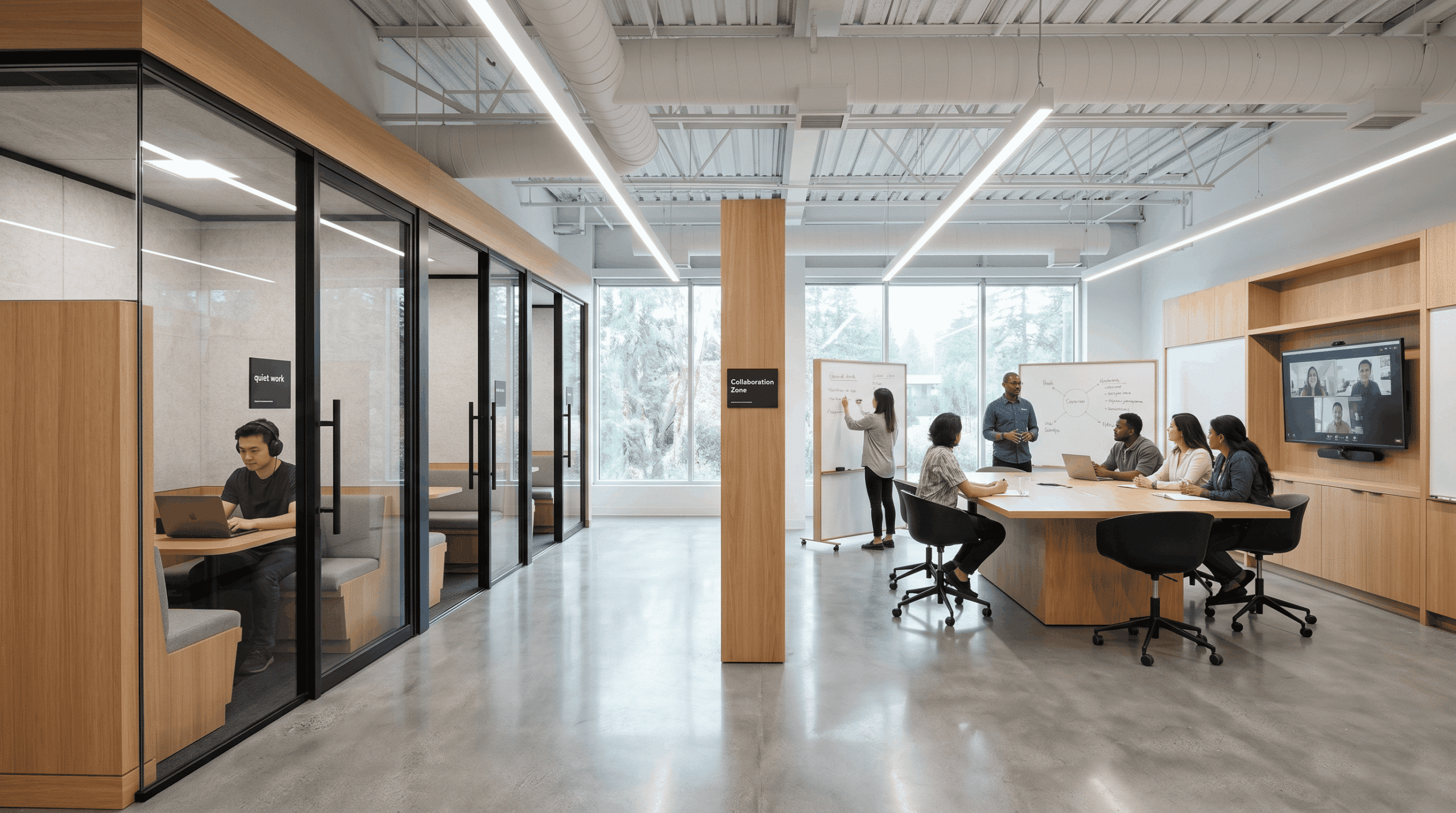
What Is Office Space Planning?
Office space planning is the discipline of matching a physical workspace to the way a team operates. It covers how many people the space needs to hold, the mix of workstations, meeting rooms, and amenity areas, and how those zones connect to one another. Done well, it shapes daily productivity, employee retention, and the cost of occupying the space. Done poorly, it produces an office that looks fine on paper but frustrates the people who use it every day.
Most business owners we work with at Cutler underestimate how much the layout drives performance. The location of the kitchen, the ratio of phone rooms to open desks, the sightlines between teams, and the acoustic separation between focus and collaboration zones all affect how the day flows. With more than 1,200 commercial projects completed and over 5 million square feet of space delivered, our team has seen the same patterns repeat: workplaces designed around how work actually happens outperform workplaces designed around aesthetics or square-foot averages.
This guide walks through the fundamentals of office space planning and office interior design in Vancouver and across Canada, including how to calculate space requirements, the zones every modern workplace needs, design ideas for small offices, and the process of working with a designer to lay out a high-performing space.
How Much Office Space Do You Need Per Employee?
Space planning starts with a number: the square footage your team needs to do its work. In Canada, the per-employee benchmark has shifted significantly since 2020, as hybrid work patterns reduced full-time desk demand while increasing the value of meeting and collaboration space. The current ranges our team uses for planning purposes:
– Dense, open-plan offices:
100 to 150 sq ft per employee. Typical for tech, creative, and call centre environments with hot-desking or hybrid attendance.
– Standard professional offices:
150 to 200 sq ft per employee. Typical for legal, financial, and consulting firms with assigned seating and moderate meeting needs.
– Executive or low-density offices:
200 to 300+ sq ft per employee. Typical for partner-led firms, private offices, and businesses with significant client-facing meeting demand.
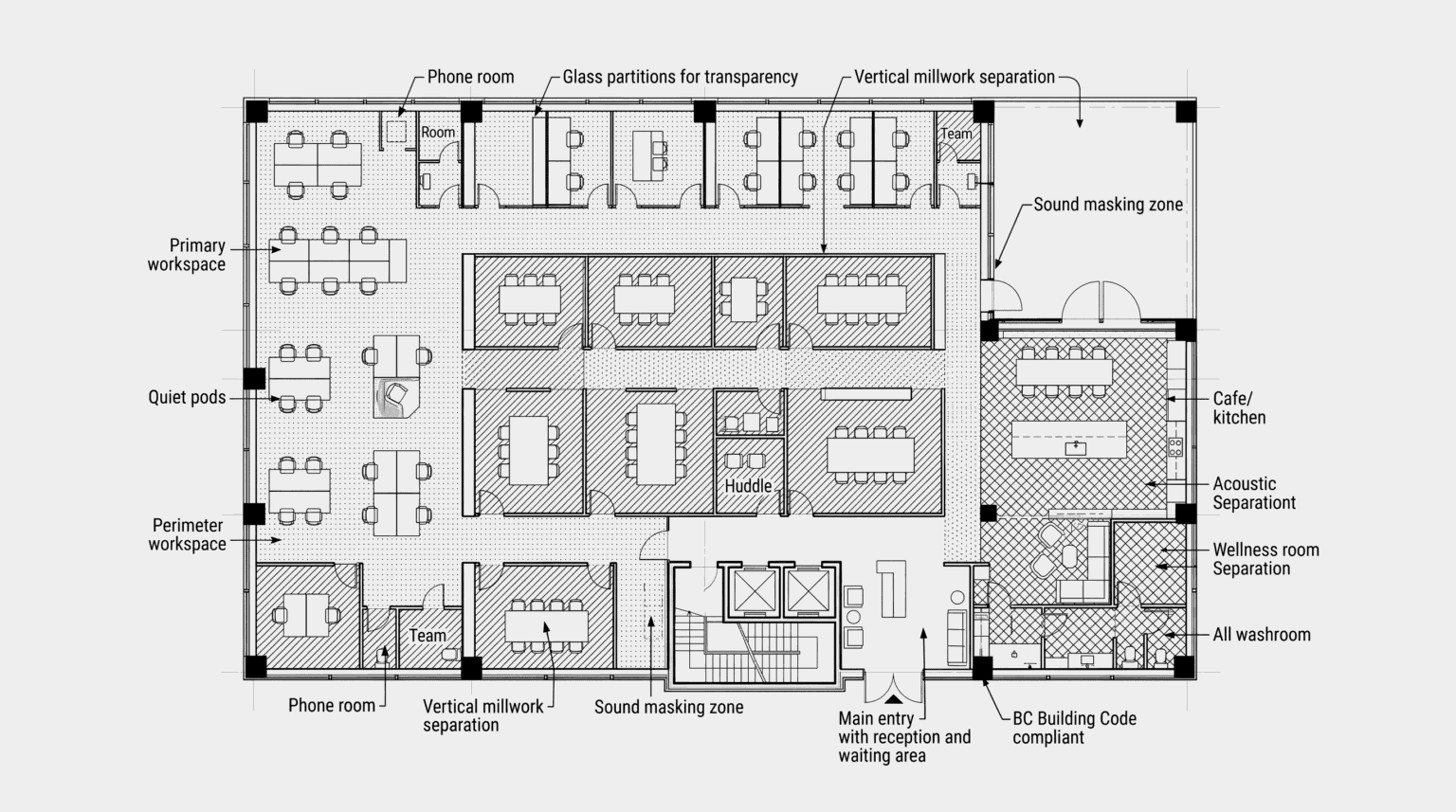
These figures include workstations, meeting rooms, circulation, washrooms, kitchen and break areas, storage, and reception. They are not raw desk footprints. A common mistake is to multiply headcount by desk size and assume that is the lease requirement, then run out of room as soon as meeting demand and circulation are added.
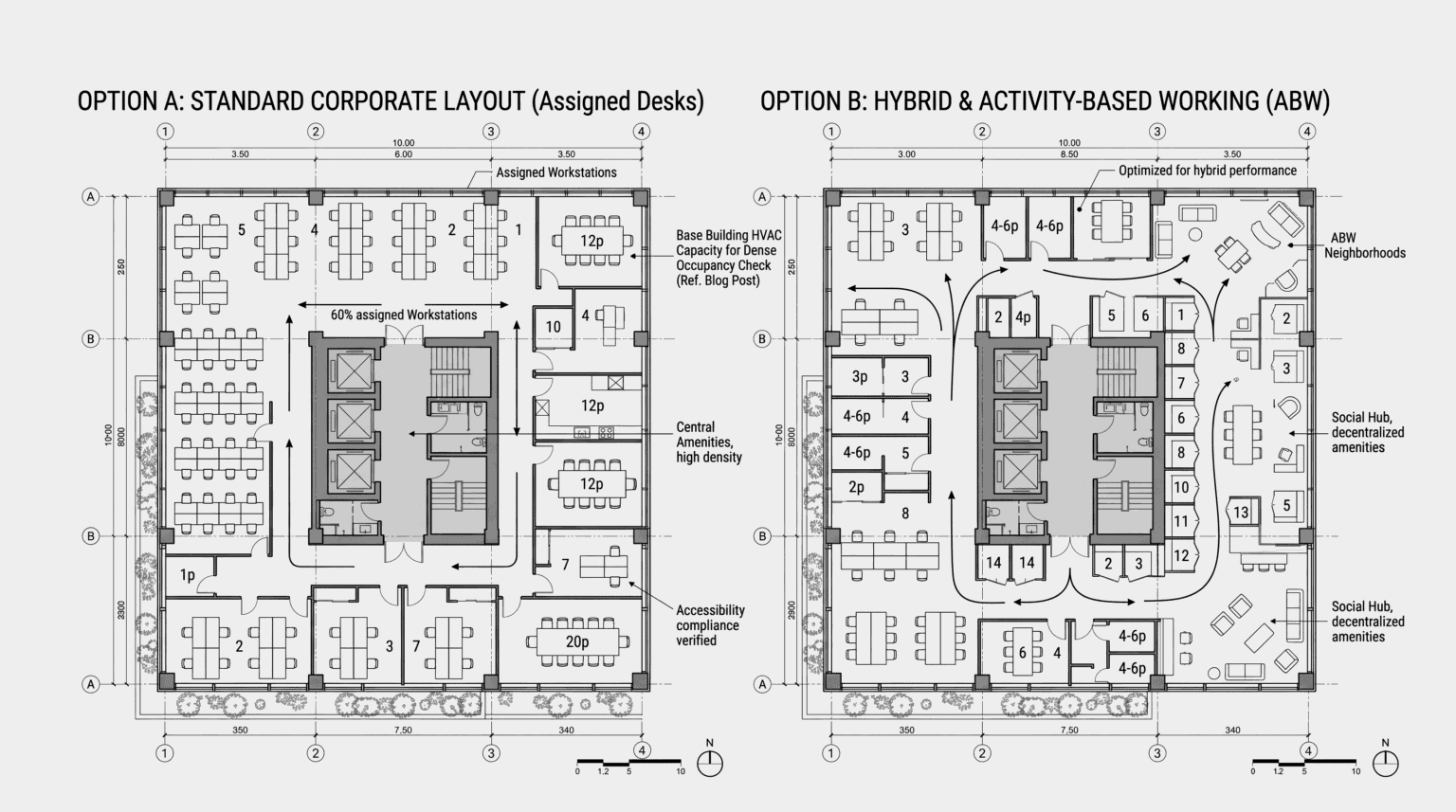
For hybrid teams, the calculation changes. If only sixty percent of your staff are in the office on a typical day, you can plan for sixty percent peak occupancy and reinvest the saved space into better meeting rooms, focus pods, and amenity zones. Hybrid planning is one of the strongest reasons to engage a designer early. The savings on rent over a five- or ten-year lease often outweigh the design fees by a wide margin.
The Three Essential Zones in Modern Office Design
Productive offices are organized into zones that match the type of work happening in them. Three zone types form the backbone of any modern workplace layout: collaboration, focus, and social. The proportions vary by industry and culture, but all three need to be present and acoustically separated from one another.
Collaboration Zones
Collaboration zones are where teams meet, brainstorm, present, and solve problems together. They include conference rooms, huddle rooms, project rooms, and open team tables. In a modern office, we typically recommend one enclosed meeting room per ten to fifteen employees, supplemented by smaller huddle rooms for two to four people. Video conferencing capability should be standard in every enclosed meeting room because hybrid meetings are now the default rather than the exception.
Open collaboration areas, such as project tables in the centre of a floor, work well when they are placed away from focused work zones. Acoustic treatment and clear sightlines are critical. A collaboration zone that bleeds noise into the focus zones costs the office more in lost productivity than it gains in spontaneous teamwork.
Focus Zones
Focus zones are where individual deep work happens. They include traditional workstations, private offices, focus pods, and quiet rooms. The office space planning challenge is to protect these zones from the noise and movement of collaboration and social areas. Tactics include locating focus zones along the building perimeter, using acoustic ceilings and partitions, installing sound masking, and dedicating a clearly signposted “library” zone with strict no-meeting rules.
Hybrid offices often need fewer assigned workstations but more enclosed focus pods. Employees who come in two or three days a week want flexibility to move between heads-down work and team interaction without leaving the floor. A small number of single-person focus pods, often four to six per fifty staff, can dramatically improve perceived productivity.
Social and Wellness Zones
Social zones, including kitchens, lounges, cafes, and outdoor terraces, are where culture is built. They are also where employees recharge between meetings, take informal phone calls, and have the unscheduled conversations that drive creative work. Wellness zones, including lactation rooms, prayer or meditation rooms, and accessible washrooms, support employee wellbeing and meet the requirements of the BC Building Code and Canadian human rights legislation.
A well-planned social zone is generous enough to handle peak lunch and break periods, separated acoustically from focus areas, and located where natural light can reach it. Tucking the kitchen into a back corner with no windows is one of the most common mistakes our team sees in older office layouts.
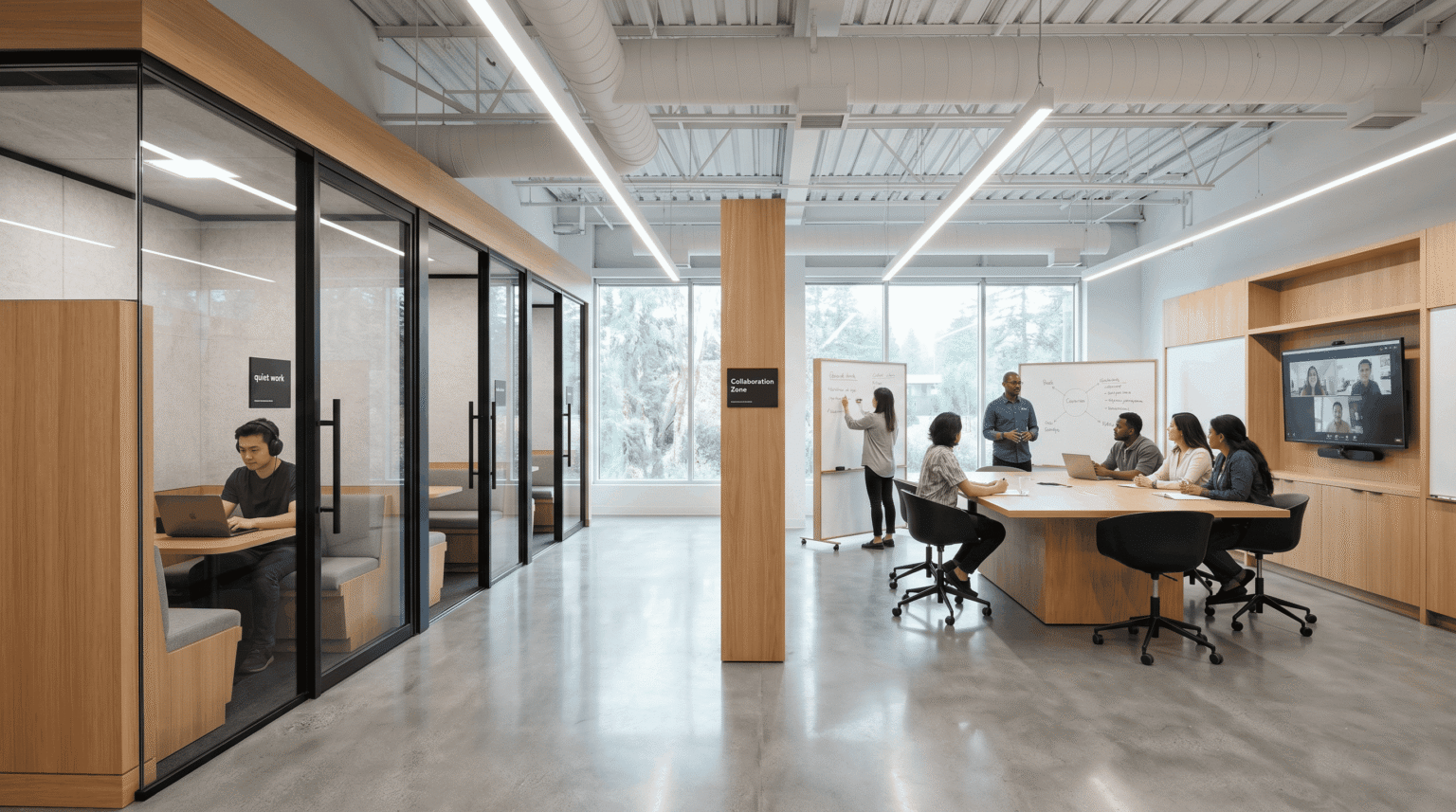
Activity-Based Working (ABW): The Modern Approach
Activity-based working is an office space planning model where employees do not have assigned desks. Instead, the office offers a variety of settings, including focus pods, open desks, project tables, lounges, and meeting rooms, and employees choose the setting that fits the task at hand. ABW is well-suited to hybrid teams, knowledge workers, and any business where the type of work varies significantly through the day.
ABW is not the right answer for every workplace. Teams with predictable, station-based work, such as accounting departments with two monitors and a ten-hour workday at the desk, often perform better with assigned seating. Client-facing teams that need a permanent base for files and equipment may also resist the model. Where ABW does work, the productivity and real estate efficiency gains can be significant, with companies routinely reducing their footprint by twenty to thirty percent without reducing headcount.
Implementing ABW well requires more than removing assigned desks. It requires a clear etiquette, a booking system, ample focus pods, lockers for personal storage, and strong leadership buy-in. Without those supports, ABW often fails and the office reverts to informal “sticky desks” within a few months.
Small Office Space Design Ideas
Small offices have advantages large ones do not: shorter sightlines, easier cultural management, and the ability to make every square foot count. The challenge is fitting collaboration, focus, and social zones into a footprint that does not have room to spare. A few design ideas our team uses regularly for offices under 3,000 square feet.
Use multi-purpose furniture and rooms. A boardroom that doubles as a quiet workroom, a kitchen island that doubles as a stand-up meeting table, or a phone booth that doubles as a focus pod can each save 80 to 150 square feet without sacrificing function. Modular furniture systems give you flexibility as the team grows.
Borrow walls instead of building them. Glass partitions, half-height millwork, and acoustic panels create separation without the cost or footprint of full walls. They also let natural light reach the interior, which makes a small office feel significantly larger.
Centralize storage and amenities. A single, well-designed storage wall, kitchen, and washroom block keeps services compact and frees up the rest of the floor for productive zones. Distributing small kitchens and storage closets throughout a small office wastes square footage that should be working harder.
Think vertically. Tall millwork, full-height storage, and ceiling-mounted acoustic baffles use space that would otherwise be empty. In offices with ten-foot ceilings or higher, the vertical dimension is often the difference between a cramped layout and a generous one.
Lean into one strong design moment. Small offices feel more memorable and intentional when one element, such as a feature wall, a custom millwork piece, or a sculptural light fixture, is given the space and budget to stand out. Spreading the design budget evenly across every surface usually produces a forgettable result.
Office Space Management: Working with a Designer Step by Step
Office space management begins long before construction. The most successful projects we deliver follow a defined process that protects the budget, the timeline, and the quality of the final space. The phases below are typical for a Canadian commercial office fit-out between 3,000 and 30,000 square feet.
- Discovery and brief. The designer meets with leadership and key staff to understand the business, headcount projections, work patterns, and brand objectives. The output is a written brief that aligns expectations before any design work begins.
- Programming and test fits. The designer translates the brief into a space program (a list of rooms and areas with target square footage) and produces test fits showing how the program lays out in candidate buildings. Test fits are the most valuable tool in early lease negotiations because they prove whether a space actually works before you sign.
- Schematic design. The chosen layout is developed into floor plans, finish concepts, and 3D visuals. Cost estimates are refined. This is the phase where major decisions about materials, lighting, and furniture are locked in.
- Construction documentation. The design is documented in a full set of drawings and specifications used for permitting, bidding, and construction. In BC, this set must comply with the BC Building Code, accessibility requirements, and any municipal bylaws.
- Construction and move-in. The designer typically administers the construction contract on behalf of the client, attending site meetings, reviewing change orders, and confirming quality. After substantial completion, the designer assists with move-in, deficiency tracking, and the warranty period.
Treating space planning as a stage you skip to save money usually costs more in the long run. Poorly planned offices drive up rent, increase staff turnover, and require costly renovations within a few years.
Modern Office Design Ideas to Consider
A few modern office design ideas have moved from “trend” to “expectation” in the Canadian market over the past five years.
– Biophilic design. Plants, natural materials, and views of nature reduce stress and improve focus. Even small offices can incorporate biophilic elements through living walls, planters, and warm wood finishes.
– Acoustic-first planning. Acoustic comfort is now considered as important as lighting. Modern offices use a mix of absorptive ceilings, sound-masking systems, and zoned layouts to keep noise levels appropriate to each area.
– Wellness-driven amenities. Showers, bike storage, lactation rooms, and quiet rooms are increasingly standard, particularly in offices targeting younger employees.
– Brand-integrated environments. The office is now part of the recruiting and client experience. Branded environments, including custom millwork, signage, and material choices that reflect the company’s identity, help reinforce culture every time someone walks through the door.
– Future-proof infrastructure. Adequate power, data, and HVAC capacity for AI workloads, video calls, and growth scenarios prevent costly retrofits later in the lease.
When Should You Hire an Office Space Planning Service in Vancouver?
The best time to engage an office space planning service is before you sign a lease. A short test fit and program review takes two to four weeks and tells you whether a candidate space can actually support your team. Bringing in a designer at this stage gives you stronger footing in lease negotiations, an accurate fit-out budget, and the ability to compare options on real performance criteria rather than asking-rent alone.
For Vancouver businesses, local market knowledge matters. Lease structures, tenant improvement allowances, permit timelines, and base building conditions vary by submarket. A designer who works in the Lower Mainland regularly will know which buildings have HVAC capacity for dense occupancy, which municipalities have longer permit reviews, and which landlords typically deliver shell space close to ready versus needing significant upgrades.
Beyond lease evaluation, our team is engaged regularly for renovations of existing offices, post-pandemic right-sizing projects, and brand refresh fit-outs that update the workplace without changing the address. If your current office no longer matches how your team works, a planning review will identify whether a layout change or a new lease is the better path forward.
Frequently Asked Questions
How much office space do I need per employee in Canada?
Most Canadian offices plan for 150 to 200 square feet per employee, including workstations, meeting rooms, kitchens, and circulation. Dense, open-plan environments can run at 100 to 150 square feet per employee, while executive or partner-led firms may plan for 200 to 300 square feet or more. Hybrid offices with sixty to seventy percent peak occupancy can plan for proportionally less, often reinvesting the savings into better meeting rooms and amenity space.
What are the key zones in a well-designed office?
A well-designed office has three core zones: collaboration zones for meetings and team work, focus zones for individual deep work, and social or wellness zones for breaks, meals, and culture-building. Each zone needs to be acoustically separated from the others, and the proportions should reflect the type of work the business does. A balanced modern office typically allocates around forty percent of usable area to focus zones, thirty to thirty-five percent to collaboration, and the remainder to social, wellness, and circulation.
What is activity-based working (ABW) in office design?
Activity-based working is an office space planning model in which employees do not have assigned desks. Instead, the office provides a range of settings, including focus pods, open desks, lounges, and meeting rooms, and employees choose the setting that best fits the task at hand. ABW is most effective for hybrid teams and knowledge workers and can reduce real estate footprint by twenty to thirty percent when implemented with the right etiquette, technology, and storage.
How do you design a small office space effectively?
Effective small office design uses multi-purpose furniture, glass and half-height partitions instead of full walls, centralized storage and amenities, and vertical space (tall millwork and ceiling features) to maximize usable area. The goal is to fit collaboration, focus, and social zones into a tight footprint without making the space feel cramped. Investing in one strong design feature, such as a feature wall or custom millwork piece, often makes a small office feel more intentional than spreading the budget thinly across every surface.
When should I hire an office space planning service in Vancouver?
The best time to engage an office space planning service in Vancouver is before signing a lease, ideally during the shortlist stage when two or three buildings are under consideration. A test fit and program review takes two to four weeks and confirms whether a space can support your team and budget. Engaging a designer this early strengthens your lease negotiation position and avoids the cost of discovering layout problems after the lease is binding.
Planning Your Next Office Project?
Office space planning is one of the most underrated levers a growing business has for improving productivity, retaining talent, and controlling occupancy costs. The decisions made before a lease is signed shape the workplace for years afterward. With more than 1,200 completed commercial projects across British Columbia and 14 years of experience in workplace design, our team helps Vancouver and Lower Mainland businesses evaluate spaces, develop programs, and deliver offices that perform.
If you are evaluating a lease, planning a renovation, or rethinking how your team uses its current space, please reach out to discuss whether Cutler is the right fit for your project.